Stories Create Referrals
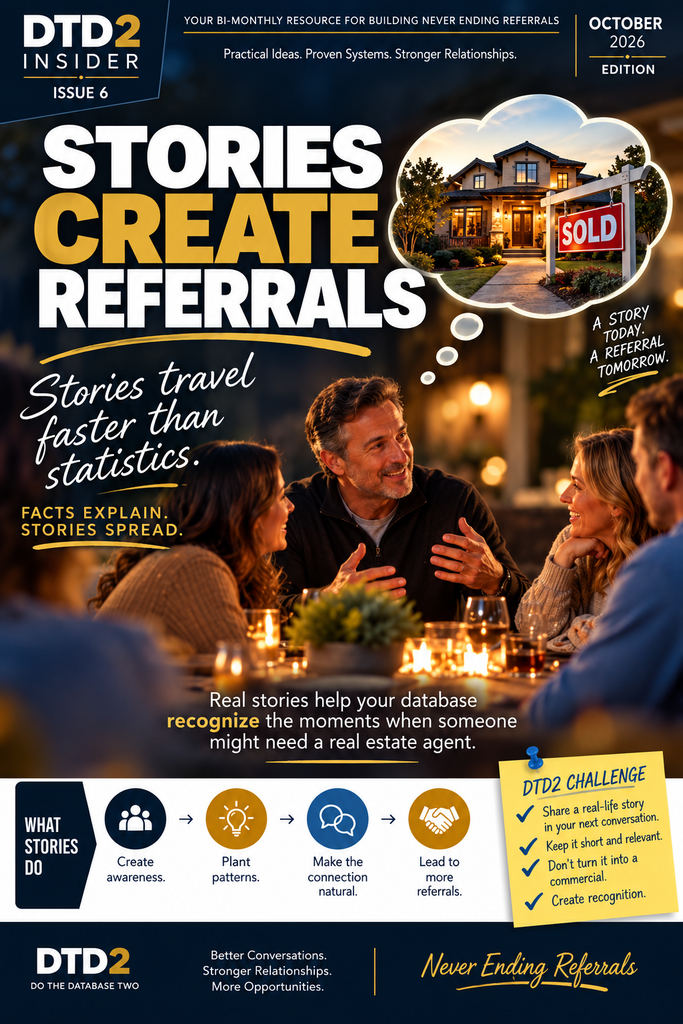
Stories Travel Faster Than Statistics
Facts explain. Stories spread.
I’ve been in real estate for nearly four decades, and one of the things I’ve come to appreciate is that people don’t necessarily remember everything we tell them about our business.
They probably won’t remember how many homes we sold last year, how many five-star reviews we have, or even how long we’ve been in the business.
But tell them a good story, and there’s a pretty good chance they’ll remember it.
And here’s where it gets interesting.
They might even tell that story to somebody else.
That’s a powerful thing when you’re building a business based on relationships and referrals.

What Do People Say About You When You’re Not in the Room?
In our last DTD2 Insider, we talked about becoming a Trusted Advisor. About earning a position in someone’s mind so that when real estate comes up, you’re someone they think about.
Well, let’s take that one step further.
Imagine someone at a neighborhood barbecue mentions they’re thinking about selling their house.
Your friend could say, “I know a real estate agent. Here’s their number.”
That’s nice. We’d certainly appreciate the referral.
But what if your friend said something like this instead?
“You ought to talk to my agent. When we sold our house, we had an offer that looked fantastic on paper. But she spotted a problem with the buyer’s financing that we never would have caught. She helped us negotiate a much stronger deal, and I’m convinced she saved us from a real mess.”
Now that’s different.
Your friend didn’t just give someone your name. They gave them a reason to trust you before they’ve even met you.
And they did it through a story.
That’s one of the principles we teach in Never Ending Referrals: when people understand the value you bring, they’re better equipped to recognize opportunities to connect you with others.
The Stories Are Already Happening
Here’s something I find fascinating. Most real estate agents have wonderful stories. They just don’t think of them as stories.
Think about your last several transactions.
Was there a buyer who was convinced they couldn’t purchase a home until you helped them understand their options? A seller facing a difficult decision where your advice helped them avoid a costly mistake?
Maybe you helped a family navigate an emotional estate sale. Or perhaps you talked someone out of selling because you genuinely believed staying put was their better decision.
Those are stories.
And the best ones aren’t necessarily about how much money you made someone or how quickly you sold their home.
They’re about what was at stake for that person and how you helped them move forward.
That’s what makes them meaningful.
The Hero of the Story Isn’t You
We’ve all met the person who can somehow turn every conversation into a story about how wonderful they are.
Nobody particularly enjoys that conversation.
The purpose of telling stories isn’t to impress people with our accomplishments. It’s to help them understand the difference that good advice, experience, and genuine care can make.
Think of a simple framework:
The Situation → The Challenge → The Difference → The Outcome
What was happening? What made it difficult? How did you help? And how did things turn out?
Sometimes a 30-second story is plenty.
For example, someone asks you how the market is doing.
You could respond with inventory numbers, average days on market, and median sales price.
Or you might say:
“It’s interesting. I was working with a seller recently who thought they needed to spend $30,000 updating their home before putting it on the market. After walking through the property and looking at the competition, we identified just a few things worth doing. They spent a fraction of what they’d planned, and we got a great result.”
You can still share the market data, but the story gives that information meaning. It helps someone understand how you think and the value of your experience.
And perhaps they’ll remember it when a friend starts talking about spending a fortune preparing their house for sale.
Give People Something Worth Repeating
This is one of the reasons I believe our DTD2 Care Conversations are so important.
We’re not calling people to deliver our latest sales pitch. We’re staying connected, being curious, and learning what’s happening in their world.
Sometimes real estate naturally enters the conversation. When it does, a relevant story can be far more effective than launching into a presentation.
But don’t force it.
If someone is telling you about their daughter’s wedding, be interested in the wedding. Not every conversation needs a real estate story.
Over time, though, people begin to understand not just that you’re a real estate agent, but what kind of real estate agent you are.
And when somebody in their world faces a similar challenge, they may remember your story.
“You know, my agent helped someone through almost exactly that situation. You ought to give her a call.”
That’s how stories create referral.s
Not because we memorized a clever script, but because we gave someone a genuine example of the value we bring.
Put It Into Practice
Here’s what I’d encourage you to do this week.
Think back over your last five or ten transactions. Choose one experience where you made a meaningful difference for someone.
Write down four things:
1. The Situation: What was happening?
2. The Challenge: What was at stake?
3. The Difference: How did you help?
4. The Outcome: What changed for the client?
Now practice telling that story in about 30-45 seconds.
Not as a commercial. Just as you would tell it to a friend.
Then, as you’re having your DTD2 conversations, pay attention to opportunities where that story might genuinely add value. Protect your clients’ privacy, and share identifying details only with permission.
And here’s one more thought.
If you want people to tell stories about you, give them experiences worth talking about.
That’s where it all begins.
Be the agent who listens a little more carefully. Who catches something others might miss. Who gives honest advice, even when it costs you a transaction.
Those moments become stories.
And those stories may travel much farther than you ever imagined.
Facts explain. Stories spread.
And sometimes, a great story is what turns a trusted relationship into Never Ending Referrals.
DTD2 | Do The Database Two
Be more human, more often, with more people.
TCPA Reminder: If you use the strategies shared in DTD2 to contact your database by phone or text, you are responsible for complying with the Telephone Consumer Protection Act (TCPA) and all applicable federal, state, and local laws. Never call or text numbers on a Do Not Call list, and do not use an autodialer, artificial voice, or prerecorded messages without the required consent. Consult your attorney or compliance professional regarding your specific business practices.
Return to the DTD2 Insider Library