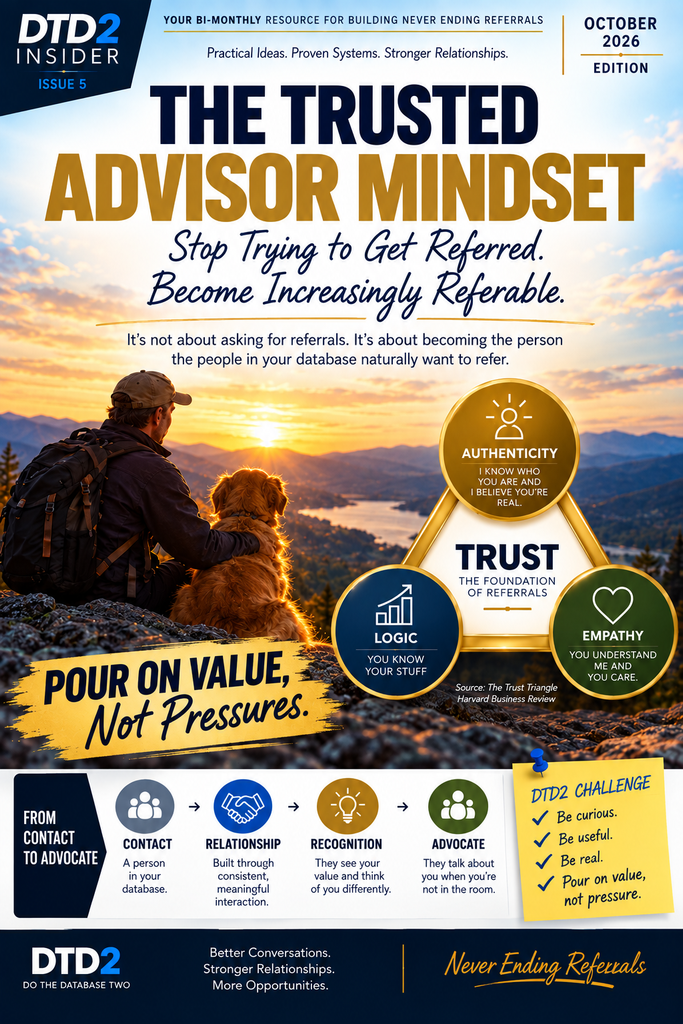
THE TRUSTED ADVISOR MINDSET
Stop Trying to Get Referred. Become Increasingly Referable.
One of the interesting things that happen when you get really good at building a relationship-based business is that you eventually stop thinking so much about getting referrals.
That may sound strange coming from someone who has spent years teaching Never Ending Referrals, but stay with me.
Most of us were taught some version of this: build a database, stay in touch, remind people you’re in real estate and periodically ask, “Who do you know who might be thinking about buying or selling?“
And there’s nothing inherently wrong with asking for business. But I think there’s a more powerful question.
Instead of asking, “How do I get more referrals from these people?” what is we asked, “How do I become the person these people naturally want to refer?“
That’s a very different way of thinking.
One focuses on what I can get from the relationship. The other focuses on the value I bring to it.
That’s the Trusted Advisor Mindset.
You Don’t Have to Be Everybody’s Friend
Here’s something else I’ve learned over the years: you don’t have to become everybody’s best friend.
Think about the people in your own database. Some of them already have another real estate relationship. Maybe their neighbor is an agent. Maybe their sister-in-law is an agent. Maybe somebody they went to college with has been selling real estate for 15 years.
Fine.
You don’t need to compete with that relationship, and you certainly don’t need to convince them that you’re a better friend.
What you can earn is a position in their mind.
When something happens in real estate that they don’t understand, are you someone whose opinion they would value? When they’re trying to figure out what their house might be worth, do they think about you? When somebody at work says, “We’re thinking about moving,” does your name have a chance of entering the conversation?
Maybe today it doesn’t.
That’s okay, because positions can change.
And we don’t change them with pressure. We change them with value.
Pour on Value, Not Pressures
That’s really at the heart of DTD2.
We’re not trying to turn every Care Conversation into a real estate conversation. We’re not calling someone under the pretense of caring about their family so we can eventually get around to asking them for a referral.
We’re building real relationships with real people.
So we stay curious. We remember what’s happening in their lives. We know our market well enough to actually be useful when real estate does come up. We share information that matters. We interpret what’s happening instead of simply forwarding another market statistic. And when someone asks our opinion, we tell them the truth – even when the truth doesn’t immediately benefit us.
Over time, all those little moments make deposits.
And eventually the person begins to think, “You know what? I trust this person!“
That’s where things get interesting.
What Actually Creates Trust?
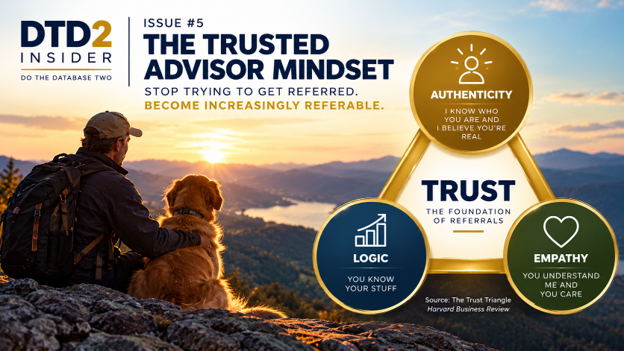
One of my favorite models for thinking about this comes from the Trust Triangle, described in the Harvard Business Review. It suggests that trust is largely built through three drivers: authenticity, logic and empathy.
I love that framework because it fits almost perfectly with what we’re trying to accomplish through DTD2.
Authenticity is the sense that I know who you are and I believe you’re real. You’re not playing a role every time you call me. I get to know your personality, your values, your stories and what matters to you.
Logic is the confidence that you know your stuff. When I have a real estate question, you bring knowledge and perspective. You don’t just give me data – you help me understand what the data means to me.
And empathy is the feeling that you understand me and you care. You listen. You’re curious. You remember. You don’t make every conversation about yourself or about the next transaction.
That’s trust.
And notice: none of those three require asking someone for a referral.
They require becoming referable.
From Contact to Advocate
This is why I think the progression matters so much.
A person starts as a contact. Through consistent, meaningful interaction, a relationship develops. As you continue creating value, they begin to recognize you differently. Recognition creates an opportunity for trust, and eventually trust can turn someone into an advocate.
CONTACT → RELATIONSHIP → RECOGNITION → ADVOCATE
Most people want to skip the middle and go straight from contact to referral.
DTD2 is about doing the middle really, really well.
Because the ultimate goal isn’t simply having someone give you a name when you ask for one.
The goal is having people talk about you when you’re not in the room.
That’s advocacy.
Someone mentions they’re thinking about selling their house, and your person says, “You need to call Steve.”
Someone says they don’t know whether they should buy right now, and your person says, “Before you do anything, talk to Steve. He’ll tell you the truth.”
That’s different.
You didn’t ask for that referral.
You earned the position that created it.
Put it Into Practice
So as you’re doing your DTD2 conversations this week, I’d encourage you to carry one question with you:
Am I trying to get something from this relationship – or am I becoming increasingly valuable within it?
Think of one person in your database where you aren’t currently the obvious real estate choice.
Don’t try to change their mind this week.
Don’t convince them.
Don’t ask them for anything.
Just make another deposit.
Be curious. Be useful. Be real.
Pour on value, not pressure.
Do that consistently enough, with enough people, over enough time, and something pretty powerful starts to happen:
You stop chasing referrals.
You start becoming the person people naturally refer.
DTD2 | Do The Database Two
Be more human, more often, with more people.
TCPA Reminder: If you use the strategies shared in DTD2 to contact your database by phone or text, you are responsible for complying with the Telephone Consumer Protection Act (TCPA) and all applicable federal, state, and local laws. Never call or text numbers on a Do Not Call list, and do not use an autodialer, artificial voice, or prerecorded messages without the required consent. Consult your attorney or compliance professional regarding your specific business practices.
Return to the DTD2 Insider Library