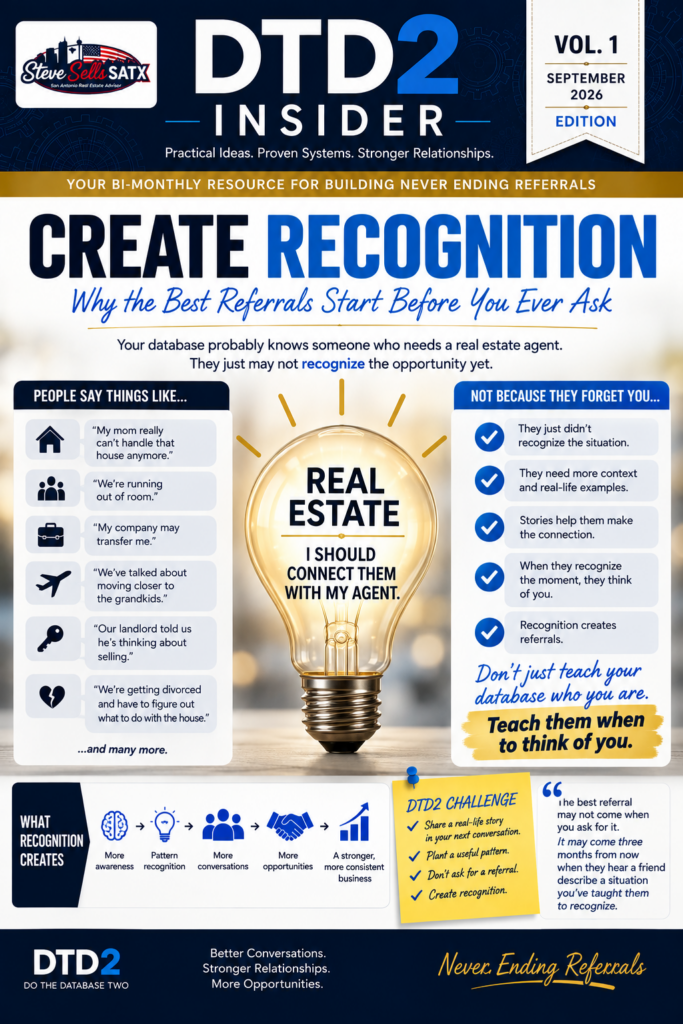
CREATE RECOGNITION
There is a big difference between asking for a referral and creating recognition.
Most traditional referral training focuses on the ask:
“Who do you know who is thinking about buying or selling?”
The problem is that most people don’t walk around with a mental list of everyone they know who might need a real estate agent.
So when you ask:
“Who do you know?”
Their brain searches for a few seconds.
Nothing immediately comes up.
And you hear:
“Hmm…I can’t think of anybody right now, but I’ll keep you in mind.”
Conversation over.
But that doesn’t mean they don’t know someone.
They probably do.
They just didn’t recognize them.
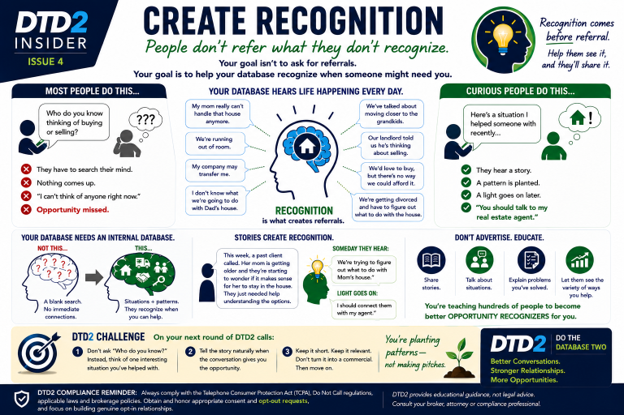
Recognition comes before referral
Think about the conversations your database hears every day.
“My mom really can’t handle that house anymore.”
“We’re running out of room.”
“My company may transfer me.”
“We’ve talked about moving closer to the grandkids.”
“I don’t know what we’re going to do with Dad’s house.”
“Our landlord told us he’s thinking about selling.”
“We’d love to buy, but there’s no way we could afford it.”
“We’re getting divorced and have to figure out what to do with the house.”
Those people may never say:
“I need a real estate agent.”
But they’re describing situations where a knowledgeable real estate professional could potentially help.
That’s the opportunity.
The goal isn’t simply to make your database remember that you’re in real estate.
The goal is to help them recognize the moments when someone might need you.
Your database needs an internal database
Think back to Issue #1.
We talked about building your Internal Database—the knowledge, stories, experiences and patterns you carry around in your head that allow you to have better conversations.
Your database needs one too.
Not a database of names.
A database of situations.
Over time, we want the people who know us to begin developing pattern recognition.
They hear:
“My parents are thinking about downsizing.”
And somewhere in their brain a little light comes on:
Real estate. I should connect them with my agent.
They hear:
“We might have to relocate.”
Light comes on.
They hear:
“We inherited my grandmother’s house and have no idea what to do with it.”
Light comes on.
That’s recognition.
And recognition is what creates referrals.
Stories create recognition
One of the best ways to create recognition isn’t by telling people what kinds of referrals you want.
It’s by telling them stories.
Imagine you’re talking with someone in your database and you say:
“I had an interesting conversation this week. A past client called because her mom is getting older and they’re starting to wonder whether it makes sense for her to stay in the house. They weren’t even ready to sell. They just needed somebody to help them understand the options.”
You haven’t asked for anything.
You haven’t said:
“Who do you know with an aging parent?”
But you’ve placed a pattern in their mind.
Aging parent + housing question = Steve may be able to help.
Someday they may hear a friend say:
“We’re trying to figure out what to do with Mom’s house.”
And now there’s something in their Internal Database that wasn’t there before.
Recognition.
Don’t advertise. Educate.
This is one of the reasons simply reminding your database that you’re a Realtor isn’t enough.
They already know that.
Your logo on a refrigerator magnet probably isn’t the missing ingredient.
What they may not know is when to think of you.
So instead of constantly advertising what you do, teach your database what to notice.
Share stories.
Talk about situations you’ve helped people navigate.
Explain problems you’ve solved.
Talk about conversations you’re having in the market.
Let them see the variety of circumstances in which you can be useful.
Over time, you’re teaching hundreds of people to become better opportunity recognizers for you.
The goal isn’t referrals
This may sound strange in a program about building a referral-based business, but stay with me.
Your goal during a DTD2 conversation isn’t to get a referral.
Your goal is to strengthen a relationship, create value and occasionally plant useful patterns.
Some conversations will produce business today.
Most won’t.
That’s okay.
Because we’re playing a longer game.
We want the people in our database going through their normal lives—talking to coworkers, neighbors, family members and friends—and occasionally hearing something that triggers:
“You should talk to my real estate agent.”
Not because we asked them to remember us.
Because we taught them what to recognize.
The DTD2 Challenge
On your next round of DTD2 conversations, don’t ask:
“Who do you know who needs a real estate agent?”
Instead, think about one interesting situation you’ve helped someone navigate recently.
Tell the story naturally when the conversation gives you the opportunity.
Keep it short.
Keep it relevant.
Don’t turn it into a commercial.
Then move on.
You are simply adding another pattern to their Internal Database.
Because the best referral may not come from someone who remembers your name when you ask.
It may come three months from now when they hear a friend describe a situation you’ve taught them to recognize.
Don’t just ask for referrals.
Create recognition.
Until next time, keep dialing—and keep creating recognition.
TCPA Reminder: If you use the strategies shared in DTD2 to contact your database by phone or text, you are responsible for complying with the Telephone Consumer Protection Act (TCPA) and all applicable federal, state, and local laws. Never call or text numbers on a Do Not Call list, and do not use an autodialer, artificial voice, or prerecorded messages without the required consent. Consult your attorney or compliance professional regarding your specific business practices.
Return to the DTD2 Insider Library