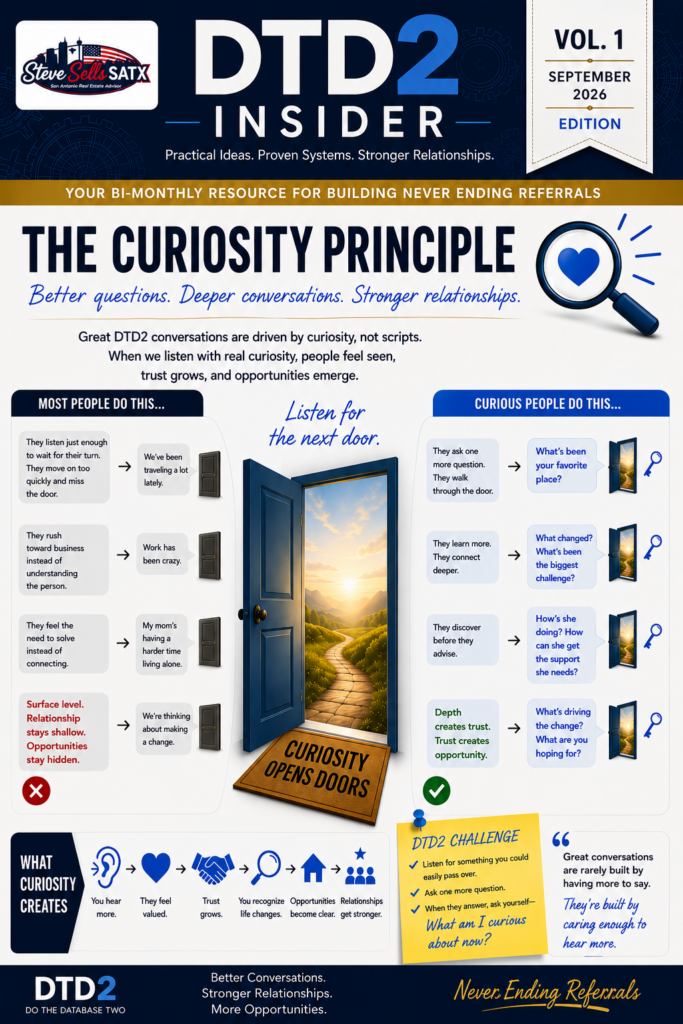
The Curiosity Principle
One of the easiest ways to make a DTD2 conversation feel awkward is to spend the whole time thinking about what you’re going to say next.
That’s what scripts often train us to do.
We listen just enough to wait for our turn.
DTD2 works differently.
The best conversations are driven by curiosity.
Not fake curiosity. Not a technique disguised as interest. Real curiosity about the person in front of you.
When someone tells you something, there is almost always another question sitting right behind it.
They say their daughter just graduated.
You ask what she’s doing next.
They say work has been crazy.
You ask what changed.
They say they may be moving.
You ask what has them thinking about that.
That is where conversations become natural.
You don’t need to manufacture a topic. The other person is already giving you one.
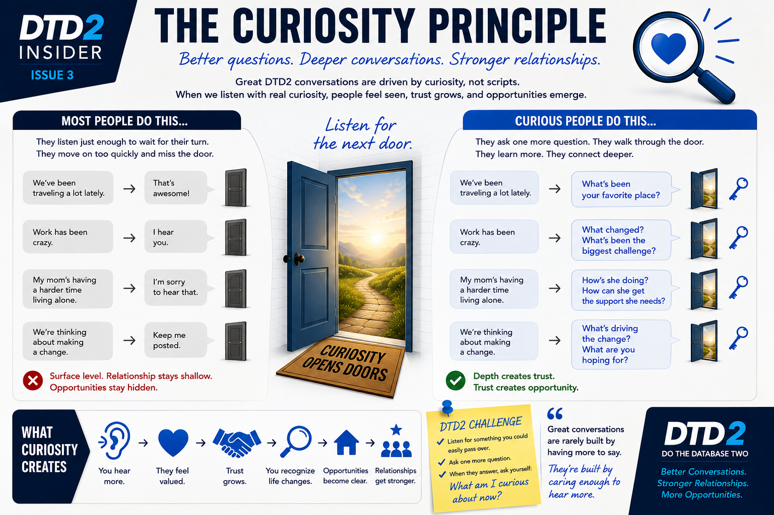
Listen for the Next Door
Think of every conversation as a hallway with doors.
People open doors constantly.
They mention their family.
Their job.
A trip.
A parent.
A house project.
A child leaving for college.
A new grandbaby.
A promotion.
A frustration.
A change.
Most people hear those comments and move on.
Curious people walk through the door.
They ask one more question.
And then they listen.
That simple habit is one of the reasons some people seem naturally good at relationships. They make others feel interesting.
And people tend to remember how you made them feel.
Curiosity beats Cleverness
You do not need the perfect line.
You do not need the perfect segue.
You do not need to sound polished.
You need to be interested.
A useful rule is:
Ask one more question before you change the subject.
If someone says, “We’ve been traveling a lot lately,” don’t immediately tell them about your last trip.
Ask:
“What’s been your favorite place?”
If they say, “My mom’s having a harder time living alone,” don’t rush toward the real estate implication.
Ask:
“How’s she doing?”
If they say, “We’re thinking about making a change,” don’t immediately ask whether they’re buying or selling.
Ask:
“What’s driving the change?”
Curiosity creates depth.
Depth creates trust.
And trust creates the kind of relationship where real estate conversations can happen naturally.
This is also where Opportunities Hide
There’s another reason curiosity matters.
Life changes create real estate changes.
A new job may mean a move.
A growing family may mean a larger home.
An aging parent may create a downsizing conversation.
A divorce may create a sale.
A new relationship may create a purchase.
A retirement may create a relocation.
But you usually don’t hear the real estate need first.
You hear the life event.
The agent who is curious hears more of the story.
And the more of the story you hear, the more likely you are to recognize where you may be able to help.
That does not mean turning every personal conversation into a real estate interrogation.
It means paying attention.
Curiosity makes the Bridge easier
In our last issue, we talked about The Bridge Principle—how to move naturally from a relationship conversation into real estate.
Curiosity actually makes the bridge easier.
If you have listened well, you often don’t need some dramatic transition.
The conversation itself gives you one.
Someone says:
“We’ve been talking about whether we should stay here after the kids are gone.”
That may naturally lead to:
“What do you think you’ll do?”
And eventually:
“Have you looked at what your options might be?”
That is very different from suddenly dropping:
“By the way, who do you know who’s looking to buy or sell?”
One feels like a conversation.
The other feels like a pitch.
The DTD2 Challenge
On your next round of DTD2 calls, try this:
Do not worry about being interesting. Be interested.
Listen for one thing the person says that you could easily pass over.
Then ask one more question.
And when they answer?
Ask yourself:
What am I curious about now?
That may be one of the simplest ways to become dramatically better at DTD2.
Because great relationship conversations are rarely built by having more to say.
They’re built by caring enough to hear more.
Until next time, keep dialing—and stay curious.
TCPA Reminder: If you use the strategies shared in DTD2 to contact your database by phone or text, you are responsible for complying with the Telephone Consumer Protection Act (TCPA) and all applicable federal, state, and local laws. Never call or text numbers on a Do Not Call list, and do not use an autodialer, artificial voice, or prerecorded messages without the required consent. Consult your attorney or compliance professional regarding your specific business practices.
Return to the DTD2 Insider Library