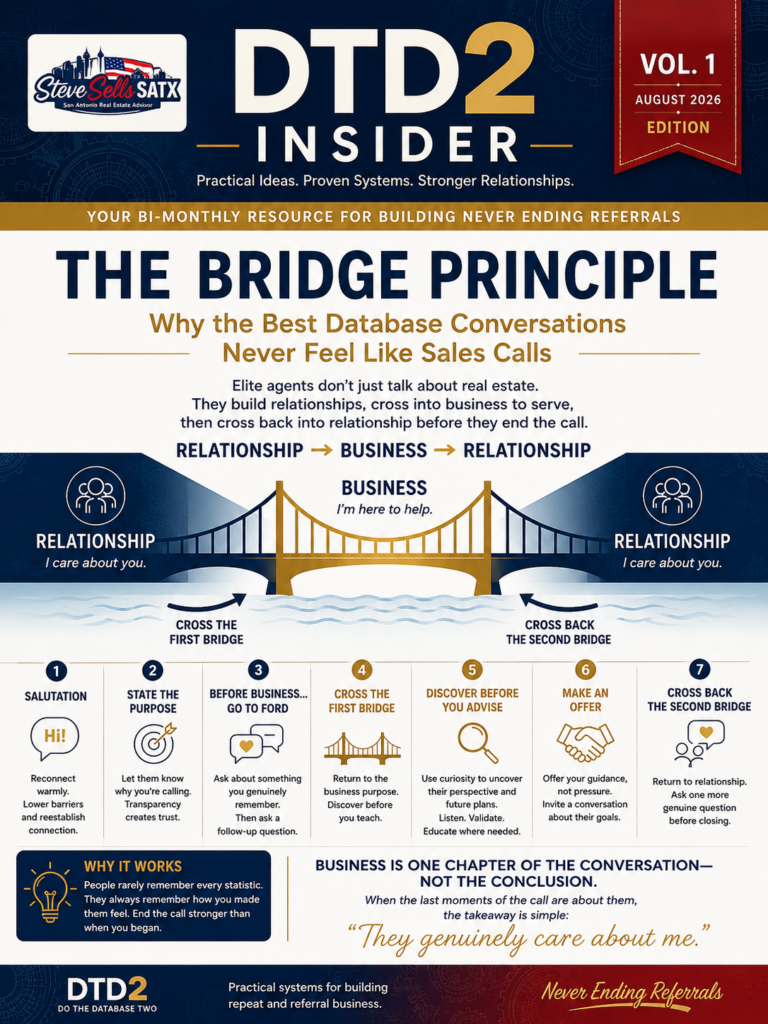
The Bridge Principle
Why the Best Database Conversations
Never Feel Like Sales Calls
In our first issue of the DTD2 Insider, we introduced the idea of your Internal Database.
The agents who consistently generate referrals aren’t carrying around hundreds of memorized conversations. They’ve built an internal database of mental models — principles that guide every conversation.
When you understand why each part of a conversation exists, you stop sounding scripted and start sounding natural.
One of my favorite examples is what we teach in the DTD2 Care Call.
If you’ve attended one of our DTD2 Power Sessions, you’ve probably seen this conversation modeled live. The amazing part? The entire conversation almost always takes less than five minutes.
Yet those five minutes strengthen relationships, uncover opportunities to serve, and often create business conversations that never feel forced.
Why?
Because of what I call…
The Bridge Principle
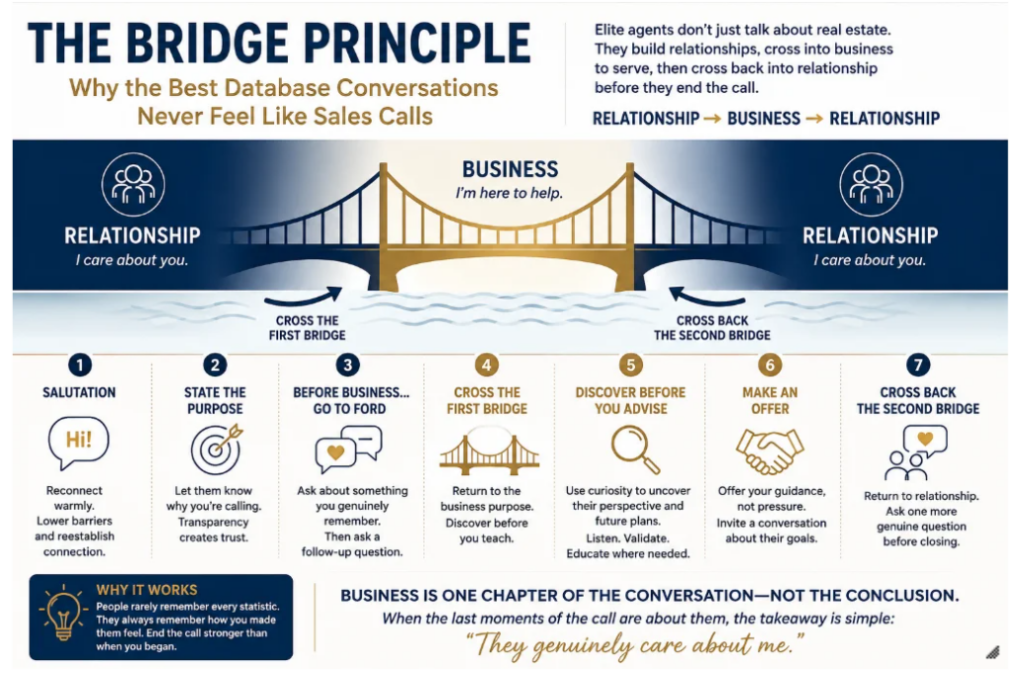
Most agents unintentionally structure their database calls like this:
Relationship → Business → Goodbye
They reconnect.
They talk real estate.
Then they end the call.
There’s nothing inherently wrong with that.
But there’s a much better way.
At DTD2, we teach a different rhythm:
Relationship → Business → Relationship
You begin by reconnecting as a person.
You transition naturally into the business purpose of the call.
Then you intentionally return to the relationship before ending the conversation.
Business becomes one chapter of the conversation — not the conclusion.
That distinction matters.
People rarely remember every statistic you shared about the market.
They almost always remember how you made them feel.
When the last few minutes of the conversation are once again about them — their family, vacation, career, kids, retirement, or what’s happening in their lives — the emotional takeaway becomes:
“They genuinely care about me.”
That’s exactly where you want the conversation to end.
Why the F.O.R.D. Sandwich Works
Many agents remember the F.O.R.D. framework.
Few understand why it works.
Each stage serves a specific purpose.
1. Start with a Warm Salutation
Reconnect naturally.
Your goal isn’t to launch into business.
Your goal is to reconnect with the person.
2. State the Purpose of the Call
If there is a business reason for calling, mention it early.
Transparency builds trust.
Something as simple as:
“You guys have been on my mind. I wanted to see how things were going, and I also had a quick real estate question for you.”
Now they know why you’re calling.
Ironically, once people know there’s a business purpose, they relax. They no longer wonder, “Where is this conversation heading?”
3. Before Business… Go to F.O.R.D.
Here’s the secret.
Before discussing business, intentionally pause.
Go back to something you genuinely remember from your last conversation.
“Last time we talked, you were planning that Smoky Mountains vacation. Did you guys end up making the trip?”
Then ask one sincere follow-up question.
That follow-up communicates something powerful.
I didn’t just remember your house. I remembered your life.
That’s a relationship.
4. Cross the First Bridge
Now return naturally to the business purpose.
“Like I mentioned earlier, I had a quick real estate question for you…”
Instead of immediately teaching, begin with curiosity.
One of our favorite DTD2 Care Call questions is:
“Just curious…what are you hearing about the San Antonio real estate market these days?”
Notice what you didn’t do.
You didn’t begin talking.
You began listening.
Listen first.
Validate what they’re saying.
Then educate only where appropriate.
You’re not trying to impress them with market statistics.
You’re helping them better understand a market that’s often confusing.
5. Discover Before You Advise
Often, one simple follow-up uncovers the real opportunity.
“It sounds like you’ve been paying attention to interest rates. Do you have anything on your real estate radar over the next 12 to 24 months?”
Notice the question isn’t:
“Are you buying or selling?”
It’s about their future.
People enjoy talking about where they’re heading.
That’s where opportunities naturally emerge.
6. Make an Offer — Not a Pitch
If there’s an opportunity to help, don’t pressure. Offer.
“Why don’t we grab coffee sometime and talk through your plans? Whether now is the right time or not doesn’t really matter. I’d be happy to help you think through your options so you can make the best decision for your family.”
Trusted advisors make offers.
Salespeople apply pressure.
Be the advisor.
7. Cross the Bridge Back
This is the step that many agents skip.
Don’t end the call after the business discussion.
Return to F.O.R.D.
“So before I let you go…anything exciting coming up this fall?”
Maybe it’s a vacation.
Maybe it’s a new grandbaby.
Maybe it’s retirement plans.
Maybe it’s a child heading off to college.
Whatever it is, ask one more genuine question.
Then listen.
The final moments of the conversation reinforce what the relationship is really about.
Not houses.
Not transactions.
People.
That’s why we call it The Bridge Principle.
You crossed into business…and then intentionally crossed back into a relationship.
Build the Mental Model —
Not Word for Word Dialogue
The goal isn’t to memorize a sequence.
The goal is to understand the purpose behind each stage.
Elite relationship builders don’t think,
“What’s my next line?”
They think,
“What does this person need from me right now?”
When you understand the purpose of each stage, conversations become natural.
You stop sounding like you’re following a script.
You simply move from connection…to service…and back to connection again.
That’s what trusted advisors do.
And that’s why DTD2 conversations feel different.
Your DTD2 Challenge
In the next 24 hours, make three Care Calls.
Don’t focus on getting an appointment.
Don’t focus on asking for referrals.
Instead, practice crossing the bridge twice.
Relationship → Business → Relationship
Pay attention to how differently the conversation feels — for both you and the person on the other end of the line.
You may discover something we’ve seen for years:
When people genuinely feel cared for…business has a remarkable way of following.
Next Issue
We’ll continue building your Internal Database by exploring another mental model used by elite relationship builders — and why mastering principles will always outperform memorizing dialogue.
TCPA Reminder: If you use the strategies shared in DTD2 to contact your database by phone or text, you are responsible for complying with the Telephone Consumer Protection Act (TCPA) and all applicable federal, state, and local laws. Never call or text numbers on a Do Not Call list, and do not use an autodialer, artificial voice, or prerecorded messages without the required consent. Consult your attorney or compliance professional regarding your specific business practices.
Return to the DTD2 Insider Library